Snap together aperiodic monotile ("einstein" or "hat")
pluckyk3g

Найти похожую с ИИ


Профиль печати(0)
Файл модели(0)
 0
0 0
0 0
0
Опубликовано:2026-02-15 04:52:01
0
0



 000
000An aperiodic monotile was discovered in 2023 by David Smith, Joseph Samuel Myers, Craig S. Kaplan, and Chaim Goodman-Strauss. It is “a single shape which tiles the plane, and can’t be arranged to have translational symmetry.” The discoverers call the shape a “hat” (though it looks a lot more like a v-neck T shirt to me). It is also sometimes called an “einstein” tile, punning on German for “one stone" (I find this confusing, and don't like it, but I seem to be outvoted. It has nothing to do with Albert Einstein, anyway.)
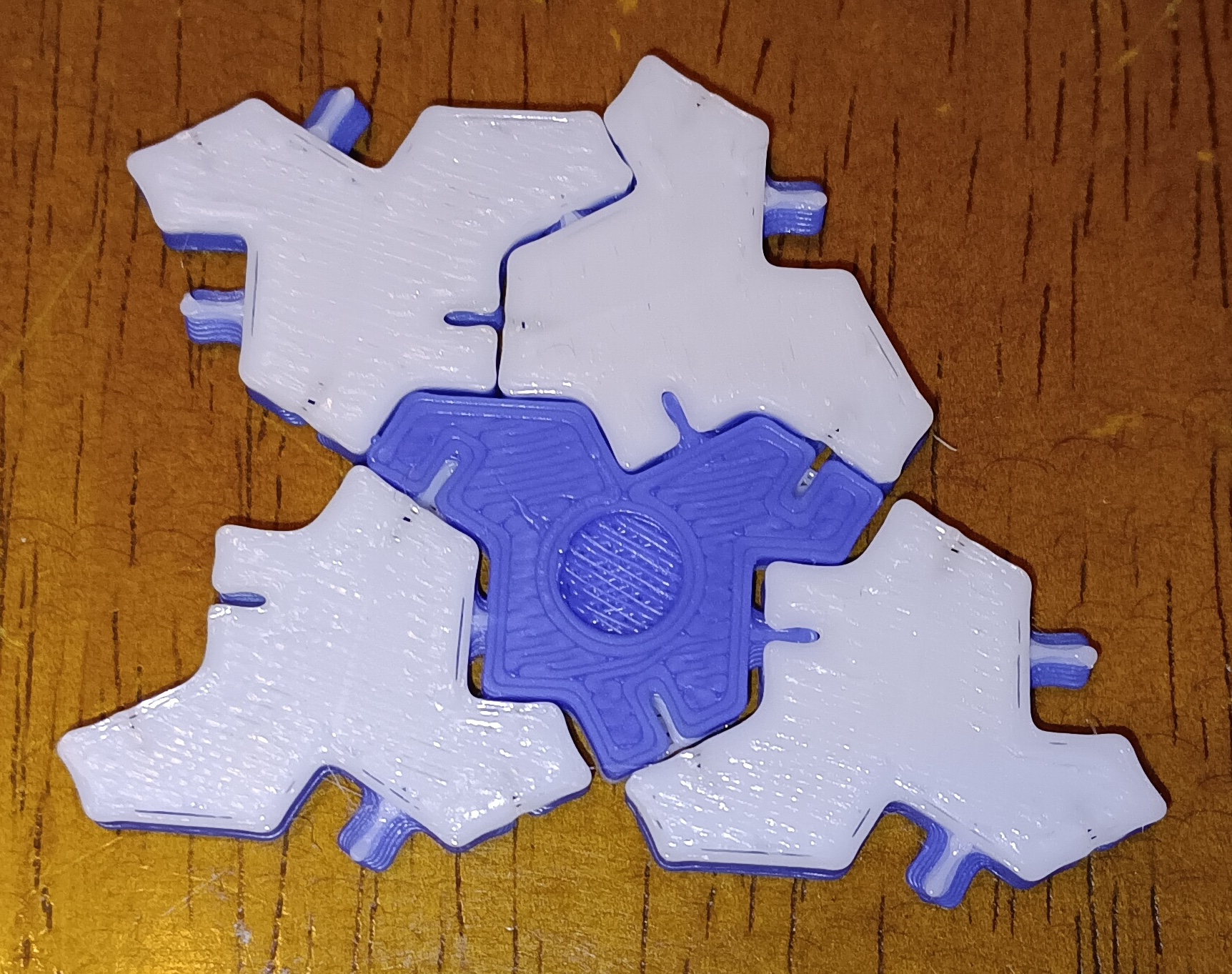
To make these usable, I have added interlocking tabs and holes. The holes are hidden except for small slits on the faces of the tiles. The tabs stick out of the concave “L” boundaries of each tile, since these must always match a convex boundary on an adjacent one. Holes are placed in convex boundaries and fit tabs if present but allow these boundaries to face each other.
I have another version in which tabs are fully hidden, but these are larger and must be constructed in two pieces. The challenge in this case was to print the tabs without overhangs. While there might be a solution that hides the tabs completely, it seemed safer to create tabs that rest fully at the base and can be printed with a 45° slope.
Each tile has two tabs and four holes, so not all holes are filled, but the tiles hold well and are liftable. It is a little tricky and can take practice attaching a new tile when both tabs must be attached. There is enough flexibility that it can be done, but you need to use three dimensions instead of inserting flat like a jigsaw puzzle.
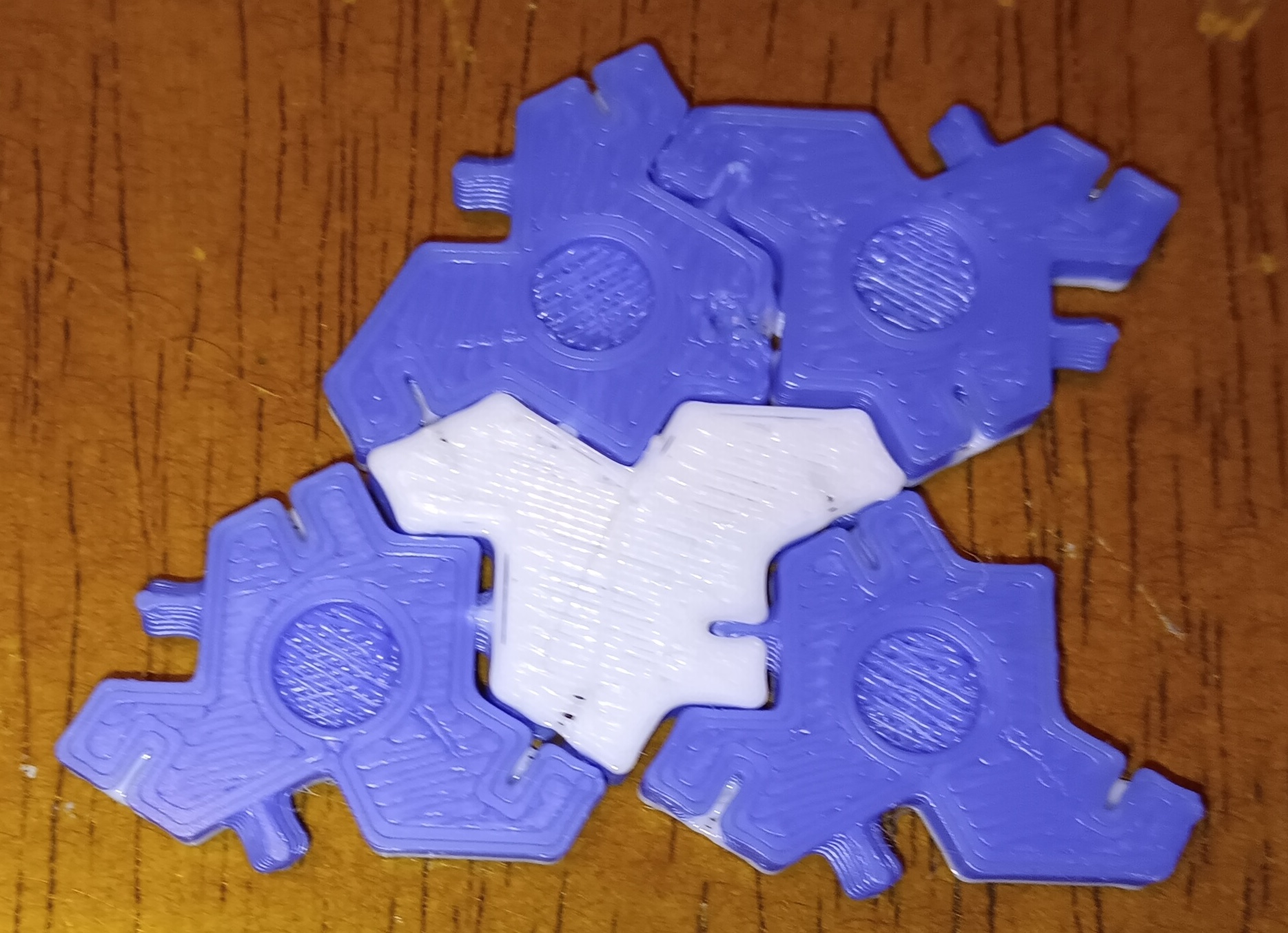
Some of these tiles must be flipped upside down in the tiling. This is indicated with a circle on the underside. If you prefer a way to print sides in different colors, take a look at the previous version.
Update: 2024-09-19: I printed a few of these in two colors, switching the filament during printing.