Mars Lithophane Terrain Lamp
FERRICK

Encuentre similares con IA


Perfil de impresión(0)
Archivo de modelo(0)
 1
1 0
0 0
0
Publicado:2024-03-25 19:10:40
2
0



 100
100This is an experimental Mars Lithophane lampshade based on NASA Mars terrain data.
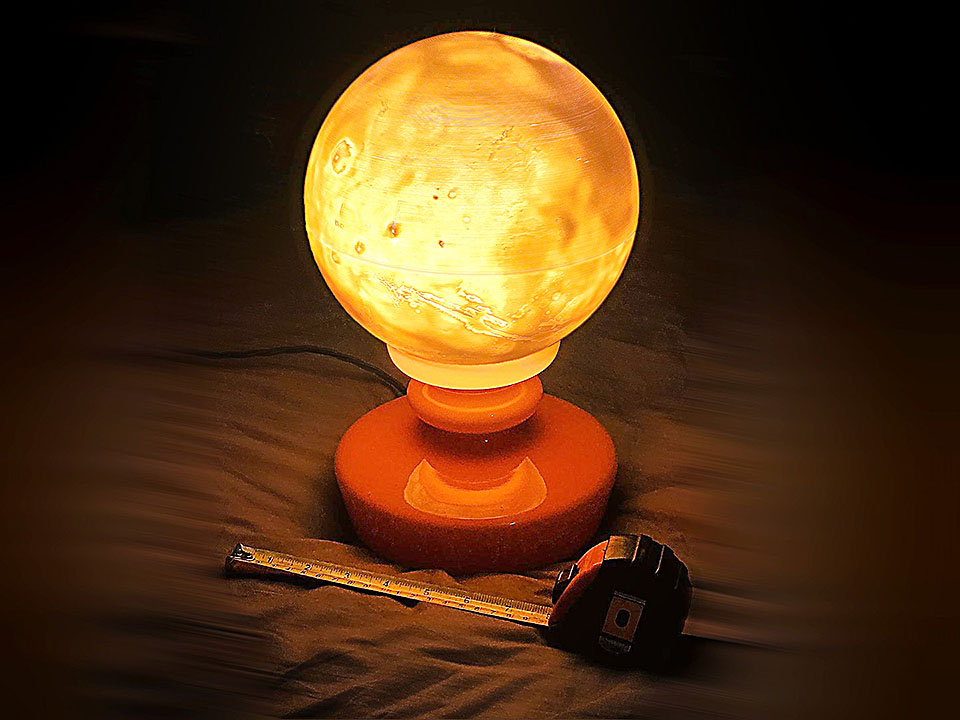 It attempts to depict Martian albedo shading (illumination) internally, and accurate Martian terrain (elevation) externally.
Achieving this in a lithophane was a challenge, as the albedo colour needed to be subtracted from the elevation data and then displaced internally against the terrain surface, towards the centre of the sphere, in order to achieve both visually good elevation, and correct relative wall thickness for the back-lighting effect to look right.
The resulting internal form from those two combined datasets looks weird and random, but is effective in creating the correct wall thickness which softly glows corresponding Martian surface albedo shades through the terrain.
So, In a nutshell, when the lamp is off, the plain white exterior looks like realistic Mars terrain elevation, and when the lamp's turned on, the back-lighting compliments the terrain contours with accurate albedo shaded illumination, glowing via the varying density of the walls (Lithophane effect).
This was designed for using with my bedside lamp, and features an 88mm hole at the south pole which aligns the lampshade with the base (centering it over the lightbulb for an even lighting effect)
I think it came out pretty good, although being printed in halves requires the two parts gluing along the equator, which did result in a thin seam line in the lighting effect.
August 2024 Update
On request i've added the complete unclipped globe for users to edit however they need to fit to their own lighting solution. The model is: MarsLithophane_Globe.stl
Printer Brand:
ELEGOO
Printer:
ELEGOO NEPTUNE 3 Pro
Rafts:
Yes
Supports:
No
Resolution:
0.4mm
Infill:
100%
Notes:
This design was done for an FDM printer in two hemispherical halves. It's sliced with the equators facing the printing plate, and because it's a large, thin walled print (especially at those equators), a good 5mm raft (or brim) is essential to ensure good bonding and stability on the plate, throughout the duration of the print.
It shouldn't need support material as the unique rough internal forms in this design do a good job of supporting all the following layers above, as the printer works its way up to the poles to complete each hemisphere.
Being a lithophane, 100% infill is important for strength and good even opacity effect when back-lit.
This print took 15 hours per hemisphere, so ~30hrs in total.
This design was developed using two NASA Mars mission datasets I downloaded from the Mars Global Data website
https://www.mars.asu.edu/data/
Albedo data (Martian terrain colour as greyscale tonal shaded equirectangular image map) Elevation data (Martian terrain elevation as greyscale height equirectangular image map)
 These images were combined in the 3D software on two highly tessellated spheres, both spherically UV mapped to correctly position the images on the Martian globe.
On the outer sphere, a displacement modifier with the elevation map is applied, giving the outer surface the realistic terrain height features, and on the inside sphere 2 x displacement modifiers are applied with the elevation map and the albedo maps subtracted against eachother, giving internal elevation of the albedo it's depth relative to the terrain surface height data.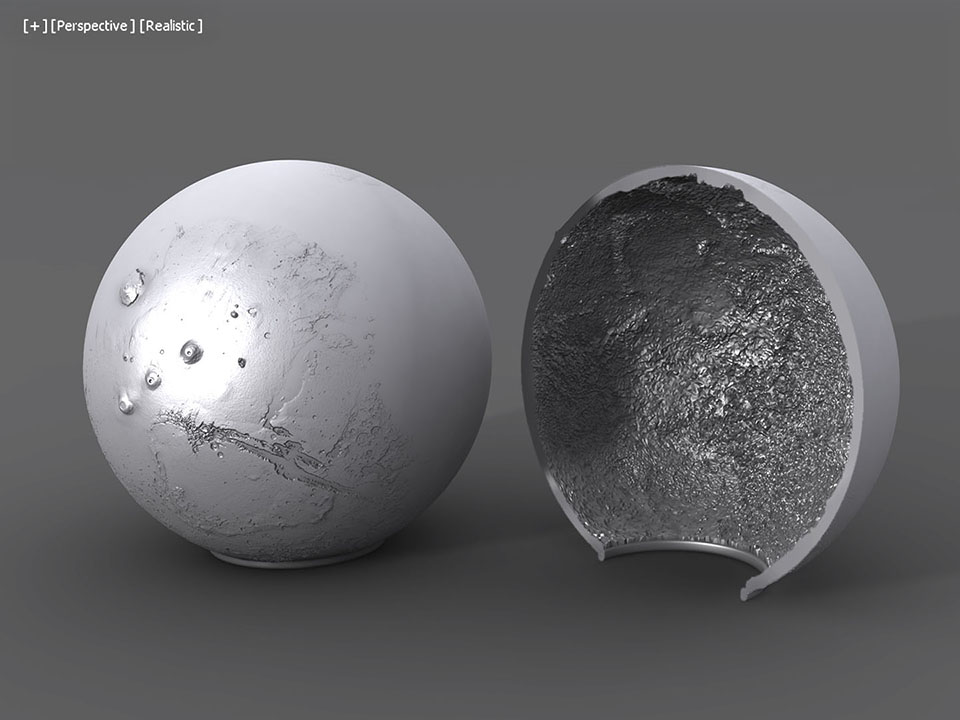 The internal form from the inside sphere's two combined datasets looks really weird and random, but is a correct result for the albedo shading as wall thickness within the print.
 The displacement of these two spheres were slightly tweaked to make sure they nest inside and don't clip eachother (avoiding errors or negative holes when sliced).
Finally the bottom was cut away flat in the model and a supporting lip added, enclosing the two spheres into volume geometry model, and allowing it to sit aligned on the lamp base.