
Optimize the disc golf throwing disc
GentlePipe01

Encuentre similares con IA

Perfil de impresión(0)
Archivo de modelo(0)
 1
1 0
0 0
0
Publicado:2025-09-07 19:59:06
0
0
 100
100This is a model of a disc golf tee pad, generated using the design optimized by numerical simulation in the paper:https://link.springer.com/article/10.1007/s00158-021-03107-7.Thank youBigBlambinoWe discovered this paper and published the original model. The outline of this tee pad was designed based on mathematical simulations, aiming to achieve the lowest resistance
The type of consumables and the weight of the Frisbee
The weight of a frisbee can be easily adjusted by changing the filling percentage. To achieve a higher frisbee weight within the range of 175-180 grams that I prefer, it is necessary to use plastics with higher densityI highly recommend using TPU for AMS as a consumable option.It's more resilient and feels more like a flying disc bought in a store.
When printing these frisbees, I noticed a strange phenomenon. The model weight predicted by the Bamboo Slicer software is about 5-10 grams higher than the actual weight of the PLA and TPU frisbees for AMS. For example, the TPU for AMS configuration I posted shows a model weight of 181 grams, but the final frisbee weighs 175 grams. It's not clear why there's such a large difference, but if you're trying to achieve a specific weight, you may need to print multiple times.
Support & Brims
You absolutely need support. Since the amount of support material is large, the type of support chosen is very important. I found that tree-like supports are the easiest to remove. In the TPU for AMS configuration I posted, I used PLA as the interface material. As can be seen from the figure below, it separated well, and only minimal polishing was needed to clean the disc. To start peeling off the PLA interface layer, it was indeed necessary to use a craft knife to cut a label in the PLA that could be clamped with pliers. But once that was done, about 95
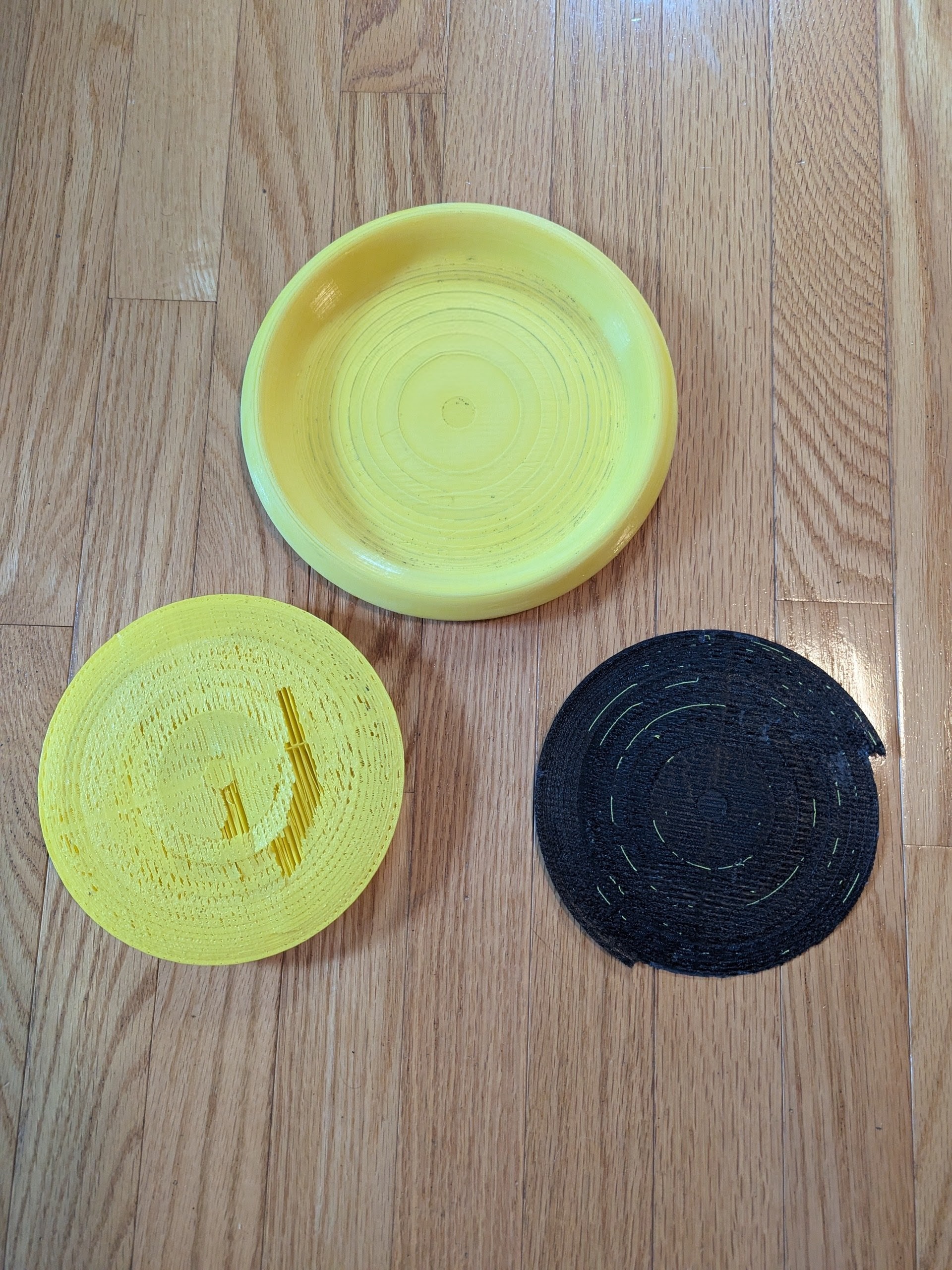
When I was developing the printing configuration in PLA, I found that internal and external brims were necessary because the model's contact area with the print bed was very small. I'm not sure if TPU for AMS absolutely requires brims, but I kept them in this configuration to increase safety.
To finally clean up the frisbee, I used a utility knife to remove the small protrusions caused by the random seam positions, and gently polished the entire edge with 400-grit sandpaper. The random seam positions were designed to eliminate the potential for weak seams that could become vulnerable during impact.
Final evaluation
As mentioned above, I don't recommend using PLA. Although my test PLA discs flew well, they were too prone to damage and bounced strangely when landing. For TPU for AMS discs, they also flew well, but landed more like a typical disc. I didn't encounter any hard impacts when using it for the first time, so I haven't yet determined its full durability. Compared to the Innova Gorgon (10/6/-2/1) regular throwing disc I'm currently using, I didn't get as much distance with the TPU for AMS