Fully Open Source A1, A1 mini Composite Damping Mat Vibration Reduction Solution
cl3atino

Mit KI Ähnliches finden


Druckprofil(0)
Modelldatei(0)
 0
0 0
0 0
0
Veröffentlicht:2026-07-26 06:17:10
0
0



 000
000
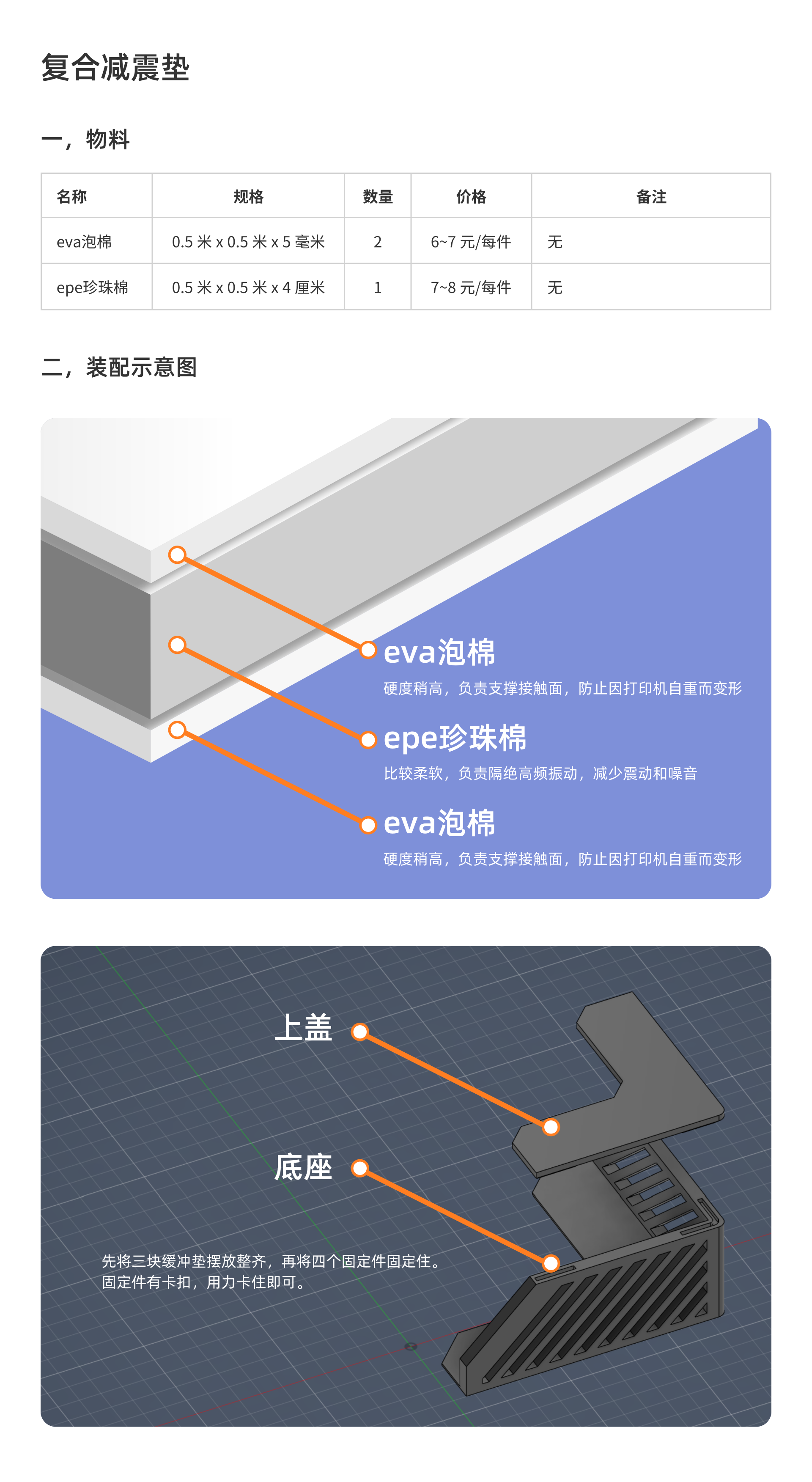
When I was searching for damping pads on e-commerce platforms, I saw a type of multi-layer composite damping pad that uses a three-layer sandwich material to isolate vibration and noise. It is commonly used for drum kits, audio equipment, fitness, and other scenarios.
I thought about using this type of pad for vibration reduction and noise reduction for 3D printers, but unfortunately, the price was too high. So I came up with an alternative solution: using two layers of high-density EVA foam sandwiching a thick layer of EPE foam. The high-density EVA foam, due to its high density, serves as the support for the contact surface, while the thick EPE foam acts as the middle layer to isolate vibrations. Then I used a 3D printer to print fixtures to secure the multi-layer damping materials, which also serve a decorative purpose. This way, the total cost is approximately within 20 yuan.
Since the 3D printer has been running at high intensity both before and after assembly, there was no downtime for detailed comparative testing. Subjectively, after using the damping pads, the vibration and noise of the 3D printer have indeed decreased. Everyone can test it themselves.
Because this solution actually has no technical difficulty or design creativity, it is completely open source. You can use it freely with attribution, and everyone is welcome to modify it.